
Need help?Contact us
This production is recommended for ages 12+.
Performance dates
19 - 30 May 2026
Run time: 1hr 20mins
No interval
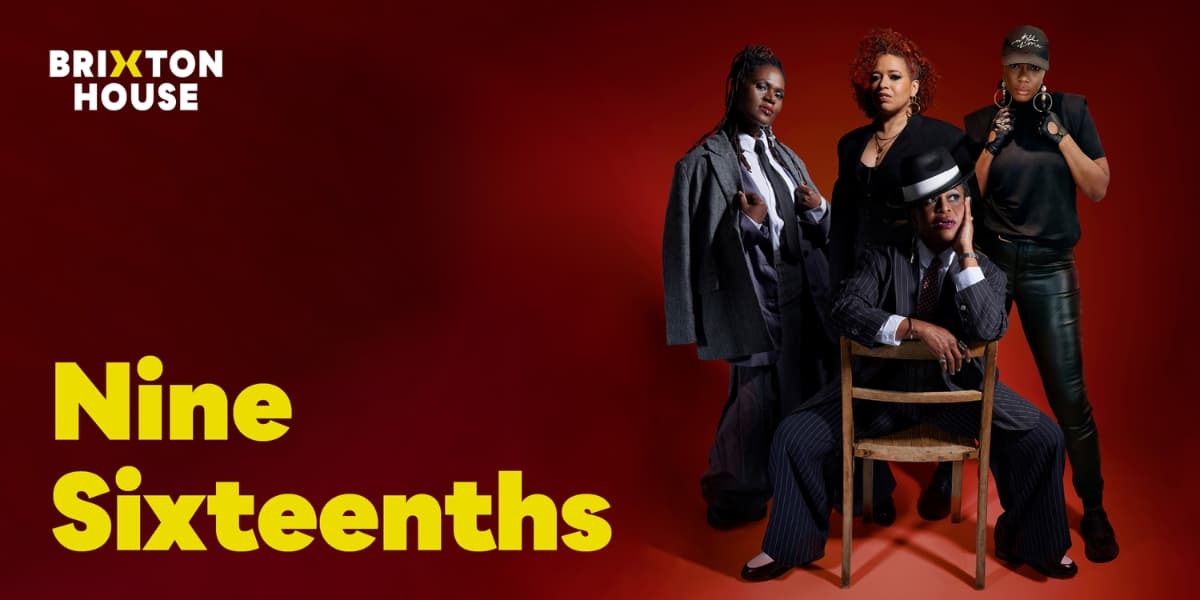
Journey through '00s nostalgia through the media storm of Janet Jackson's 2004 SuperBowl halftime show with Nine Sixteenths. Playing a strictly limited run at Brixton House, book your official tickets today
In 2004, the Super Bowl halftime show sparked global controversy when Justin Timberlake exposed Janet Jackson’s breast for just nine-sixteenths of a second. Despite Jackson’s status as a pop icon, Black role model, and LGBTQ+ ally, the backlash derailed her career, while Timberlake’s flourished, exposing a powerful double standard in media, race, and gender.
Nine Sixteenths examines who controlled the narrative and why Black women are so heavily scrutinised in the public eye. Told in three acts; The Malfunction, The Aftermath, and Reclamation, the show fuses devised theatre, dance, and lip sync with early-2000s pop nostalgia, centering four Black female performers as they reclaim visibility, power, and voice.
Nine Sixteenths contains strong language, and references to sexism and racism.
Growing up in the 1990s, theatre maker Paula Varjack was a huge fan of Janet Jackson. “She was a real icon for me,” says Varjack, whose ensemble show Nine Sixteenths opens at Brixton House in next week following an acclaimed out-of-London tour. As indeed she was for a lot of young black women. It was not until Varjack saw Jackson perform at Glastonbury in 2019 that she started wondering why Jackson had fallen off her radar.
What she discovered was that Jackson had had a considerable output between 2004, when she was the first black woman to command the Super Bowl halftime slot, and 2019, but somehow Varjack had remained unaware of it. Was that the case for others too?
“It was so strange, as if she had lost a sense of her own narrative. She had been huge, and then suddenly she wasn’t. She didn’t stop making music, but it just wasn’t heard widely. I wanted to know what had happened?"
Intrigued, and with support and a grant from Complicité, Varjack began to investigate further. What she discovered has fed into Nine Sixteenths, a show which is both a coming-of-age story about the icons who shape our thinking but which also digs beneath the surface to explore representation and pop culture and asks who controls which and whose narratives.
In 2004 Jackson was at the height of her fame; hence the invite to perform at the Super Bowl. All was going well during the performance, and towards the end she invited a young Justin Timberlake to join her on stage.
During their brief performance together, Timberlake ripped her top away in a rehearsed move. Jackson's bustier was supposed to remain in place, but the costume malfunctioned, and for nine-sixteenths of a second, Jackson’s nipple was exposed on live TV. This fleeting, unplanned exposure happened when the internet was still in its infancy, so it was not shared in the way it would be now, but the impact on Jackson’s career was catastrophic.
The young Timberlake came out of the incident unscathed, and he went on to perform at the Grammys the following week, but Jackson had her invitation to perform at the Grammys rescinded, and for five years her music did not get airplay on radio stations and MTV.
“Her output was blocked; effectively, she had been cancelled,” explains Varjack. “Her career did eventually recover, but I wondered what it might have been if she had not been cancelled.” She points out that it was 10 years before another female black artist—Beyoncé—headlined the Super Bowl.
14 May, 2026 | By Lyn Gardner